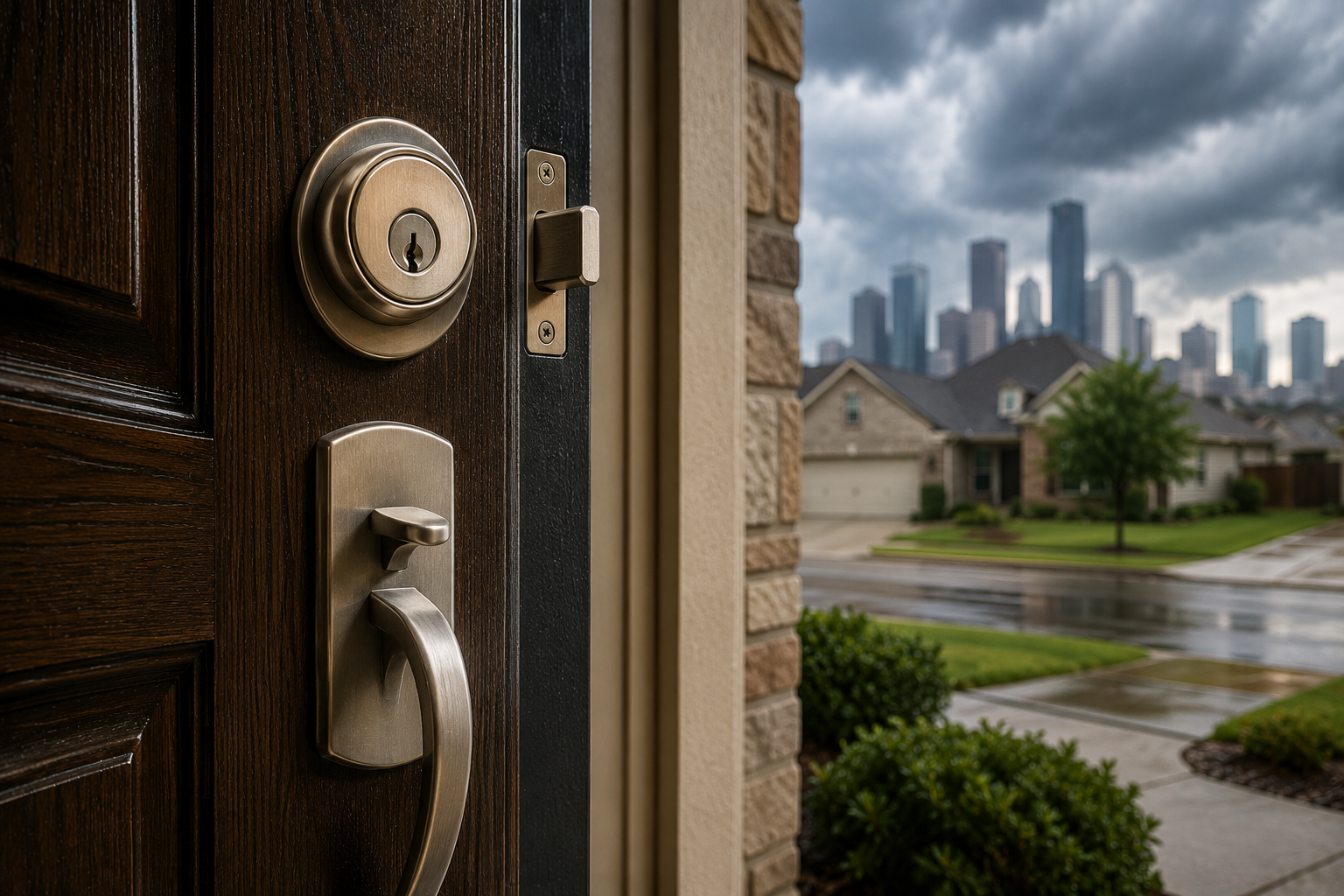
Most Houston homeowners assume that if there's a deadbolt on the front door, the door is secure. That's a reasonable assumption, but it's often wrong, and in a city like Houston where home burglaries are a real and documented concern, the gap between what people think their locks are doing and what those locks are actually capable of is worth understanding.
The truth is that not all deadbolts are built the same way, and the difference between a lock that holds under forced entry and one that fails in seconds isn't always visible to the naked eye. Plenty of Houston homes have locks installed during construction that meet the bare minimum to pass code. Grade 3 hardware that a determined intruder can defeat with basic techniques in under a minute. The homeowner has no idea, because from the outside, the lock looks like a lock.
This guide breaks down what EZ Lock & Key Assist wants every Houston homeowner to understand about the hardware on their doors and what the grading system means, what to look for on your own, and what it actually takes to make a front door genuinely resistant to forced entry.
The Lock Grade System Most Houston Homeowners Have Never Heard Of
Lock hardware sold in the United States is graded by the American National Standards Institute, under a rating system that runs from Grade 1 at the top to Grade 3 at the bottom. These grades reflect testing results across a range of measurements: how many door cycles the lock can withstand before failing, how much force it can resist before the bolt or cylinder gives way, and how well it holds up against specific entry attack methods.
Grade 3 — Builder Standard, Minimum Protection
Actually this is what EZ Lock & Key Assist locates in various homes around Houston when we receive a call for lock evaluation. It should be understood that Grade 3 devices are used in all buildings since this material stipulates the code requirements, and at the same time, reduces construction expenses. This means that this grade meets only the minimum standard for residential locking devices so that the tests of this grade reflect this minimum, the cycle counts are below the average, strength resistance is weak, and the materials are not thick enough. In practice, Grade 3 locks can be removed easily by means of repeated kicks to the door frames, or with the help of shims or simple tools to open the lock.
Grade 2 — Improved but Still Mid-Range
Grade 2 hardware is significantly stronger compared to Grade 3 and is a real upgrade in terms of security. It is the hardware that EZ Lock & Key Assist usually considers the minimum for Houston homes where a homeowner wants decent security while not going for high security. Grade 2 deadlocks are equipped with stronger inner parts, better tolerances, and improved resistance to the most common break-in methods. In most situations of residential application in Houston, Grade 2 deadlocks mounted properly on a reinforced door frame offer a real level of security.
Grade 1 — Commercial Strength, Residential Application
Grade 1 is the highest ANSI classification and is typically specified for commercial applications, but it's increasingly relevant for Houston homeowners who want the highest level of residential security. Grade 1 hardware uses hardened steel internal components, anti-pick pin configurations, and reinforced bolt construction that resists the full range of attack methods, including picking, bumping, and physical force. For homes in Houston with higher security requirements, or simply for homeowners who want the best available residential hardware, Grade 1 deadbolts installed by EZ Lock & Key Assist represent a meaningful and lasting upgrade.
Why Houston's Climate Makes Lock Quality Matter Even More
Houston's heat and humidity are a real factor in lock hardware performance that doesn't come up in most conversations about residential security. The combination of high ambient temperatures, extreme summer heat, and Gulf Coast moisture creates conditions that accelerate the wear on lower-quality lock hardware faster than in more temperate climates.
Grade 3 hardware uses thinner metal components and lower-tolerance manufacturing. In Houston, those thinner components expand in heat, contract at night, and over several years of this cycling, they develop play and misalignment that degrades the lock's function. Cylinders that were already less precise from the factory become looser. Springs that were already lighter weaken further. The result is a lock that was marginal to begin with and gets progressively less effective in Houston's specific environment.
EZ Lock & Key Assist's technicians see this across Houston regularly — locks that were installed four or five years ago that have already developed the kind of wear that makes them significantly easier to bypass than the day they were installed. Upgrading to Grade 2 or Grade 1 hardware that uses solid brass cylinders and hardened steel bolts is a longer-term investment that holds up to Houston's conditions rather than degrading with them.
How to Assess Your Own Houston Home's Locks Right Now
You don't need to be a locksmith to get a quick read on where your Houston home's security stands. Here's a practical self-assessment you can do in about ten minutes.
Look for the Brand Name on the Lock
Most residential lock hardware has a brand name stamped on the face of the deadbolt or on the inside of the lock assembly. If you see a brand name you recognize from the hardware store, where the common builder-grade brands are widely distributed at big-box stores and are almost always Grade 3. That's a signal worth taking seriously. High-quality residential hardware often carries a warranty statement on the packaging and the grade designation. If you can't find a grade marking anywhere on your lock, it's almost certainly Grade 3.
Check the Bolt Throw
When you turn your deadbolt key to the locked position, look at how far the bolt extends into the door frame. A proper residential deadbolt should throw at least one full inch into the strike plate opening. If the bolt looks stubby or extends less than that, the lock's physical resistance to forced entry is limited even before considering the grade of the hardware.
Look at the Strike Plate and the Screws
Open your door and examine the strike plate on the frame. The metal plate with the hole the deadbolt goes into. If it's a small single-piece plate with two or four screws, those screws are almost certainly the short builder-grade ones that anchor only into the jamb trim. This is the most common security vulnerability EZ Lock & Key Assist finds on Houston homes, and it's one of the fastest and most cost-effective things to address.
Note How the Lock Feels in Operation
Turn your key in the deadbolt a few times and pay attention to how it feels. A lock in good condition and with good manufacturing tolerances should operate smoothly and consistently with minimal play. If there's any wobble in the cylinder, resistance that requires force to overcome, or inconsistency in how the bolt engages, the hardware has either worn out or was never high quality to begin with. Either situation is worth a conversation with EZ Lock & Key Assist.
Look for the Brand Name on the Lock
Most residential lock hardware has a brand name stamped on the face of the deadbolt or on the inside of the lock assembly. If you see a brand name you recognize from the hardware store, where the common builder-grade brands are widely distributed at big-box stores and are almost always Grade 3. That's a signal worth taking seriously. High-quality residential hardware often carries a warranty statement on the packaging and the grade designation. If you can't find a grade marking anywhere on your lock, it's almost certainly Grade 3.
What EZ Lock & Key Assist Does for Houston Homeowners Concerned About Lock Quality
When Houston homeowners call EZ Lock & Key Assist to evaluate their residential security, our approach starts with an honest assessment of what's actually on the doors right now — the lock grade, the condition of the hardware, the quality of the strike plate installation, and the overall integrity of the door frame. We don't start by recommending replacements. We start by telling you what we actually find.
Where upgrades make sense, EZ Lock & Key Assist installs Grade 2 or Grade 1 deadbolts, reinforced strike plates with structural screws, and in cases where homeowners want keyless entry, smart lock hardware that meets the same security grade standards as the physical hardware it replaces. All of our lock installation work in Houston uses hardware that's appropriate for the local climate conditions and matched to the specific door type and frame construction.
Houston homeowners who aren't sure whether their locks are adequate don't need to guess. A call to EZ Lock & Key Assist gets you a straight answer based on what we actually see at your home and not a sales pitch, and not a vague reassurance that everything looks fine without a real assessment behind it.
Contact EZ Lock & Key Assist for a Lock Assessment in Houston, TX
EZ Lock & Key Assist has served Houston residents and businesses for several years, and residential lock quality assessments and upgrades are a consistent part of what we do throughout the city. If you're in Houston and you're not certain what grade of hardware is on your doors, or if you've been putting off a lock upgrade and want to understand what it actually involves and costs, give EZ Lock & Key Assist a call.
We're licensed, insured, and available for both scheduled security assessments and emergency locksmith calls throughout Houston. Visit lockkeyassist.com or call us directly to schedule a visit. Your front door lock is either doing its job or it isn't; EZ Lock & Key Assist will tell you which one.